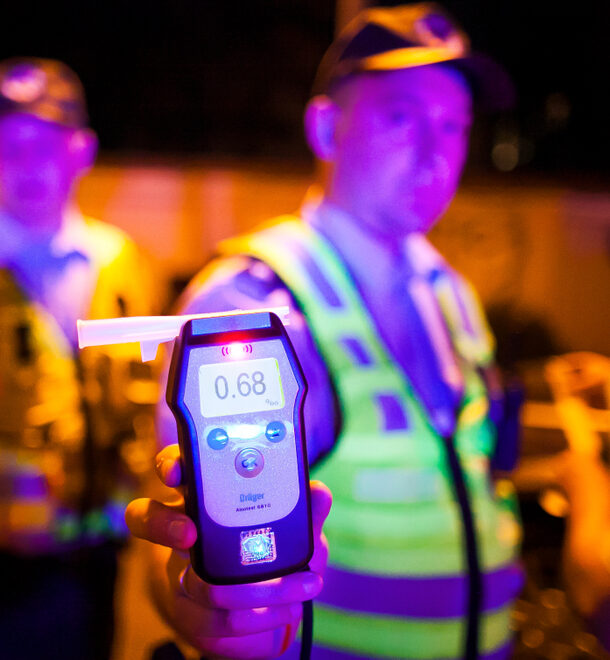
Be aware of the potential repercussions of refusing a field sobriety test before you decide to do so. You can refuse a chemical test, but it has legal consequences, such as driver’s license suspension and fines. Further, a refusal can – and will – be used against you by the prosecution to prove you are guilty of driving under the influence (DUI).
If you have refused an alcohol test requested by a police officer, you’ll want to hire the best Glendale DUI lawyer you can. The Law Office of John Phebus is experienced and ready to assess your case.
If you would like to discuss options on your case and how we can provide legal help, contact The Law Offices of John Phebus Criminal and Personal Injury Lawyer today
Refusing a breathalyzer test comes with consequences. In Arizona, like most states, there are “implied consent” laws that require drivers to submit to a breathalyzer test if they are suspected of driving under the influence. When you obtain a driver’s license, you are deemed to have given your consent to be tested for alcohol or drugs if you are pulled over for suspicion of impaired driving.
Refusing a breathalyzer test can lead to immediate repercussions, like the automatic suspension of your driver’s license. Even if you were eventually deemed sober and not guilty of the DUI charge, you can still have your license suspended for refusing the alcohol test.
Further, research shows breathalyzer tests have a 50 percent margin of error compared to blood tests. Breathalyzer readings are affected by medication usage, age, gender, rate of alcohol consumption, and even your emotional state. Your Scottsdale DUI Lawyer can challenge the accuracy of a breathalyzer test, which prevents you from facing the penalties of refusing a breathalyzer.
If you refuse to take a chemical alcohol test, like a breathalyzer, in Glendale or anywhere in Arizona, when asked by law enforcement, you will face administrative penalties. If you refuse to submit to a breathalyzer test, you can lose your driving privileges for 12 months on a first offense. For subsequent offenses, the suspension period increases.
Refusing a breathalyzer test also does not absolve you from potential criminal charges. Even if you refuse a breathalyzer, the police are still free to gather other evidence, such as observations of your behavior, to support a DUI arrest. The prosecutor can build a DUI case without breath test results, so you can still face charges. Refusing a breathalyzer also can look like an admission of guilt to most judges and juries.
In Arizona, you have the right to refuse a field sobriety test. Field sobriety tests are a series of physical and cognitive tests that law enforcement officers ask you to perform if they suspect you are driving intoxicated. These tests are used to assess your coordination, balance, and ability to follow instructions. Examples of field sobriety tests include walking in a straight line, standing on one leg, or tracking an object with your eyes.
Implied consent laws do not apply to field sobriety tests. However, if you refuse, the officer will likely request a breathalyzer test or find other justifications for your DUI arrest based on their alleged observations. If you were arrested and the traffic stop involved the refusal of field sobriety tests, consult with a Glendale DUI defense attorney immediately. They can discuss the best defense approach.
As stated above, when you get your Arizona driver’s license, you give your consent to be tested for alcohol or drugs when pulled over for suspicion of drunk driving. However, chemical testing is considered a protected search under the Fourth Amendment of the United States, so officers cannot force these tests whenever they choose.
You have the right to refuse, but police officers can often obtain a warrant for a blood test, which will give them evidence of your BAC for the DUI case. A warrant allows them to perform a lawful “search,” which is a chemical test under these circumstances.
The penalties for refusing a breathalyzer test might vary depending on the circumstances. In Arizona, if you refuse to take a breathalyzer test for a first offense, your driver’s license will most likely be suspended for a year. For subsequent refusals, the suspension period can increase to two years. In addition to license suspension, refusing a breathalyzer test can also result in steep fines. In Arizona, refusing a breathalyzer can cost you $250 for a first offense or up to $500 for subsequent offenses.
There are two main types of breathalyzer tests: pre-arrest and post-arrest. Pre-arrest breathalyzers are conducted at the scene of the traffic stop, while post-arrest breathalyzers are administered at the police station or other designated testing facility. In Arizona, pre-arrest breathalyzer tests are the norm if you are pulled over and there is reasonable suspicion of driving under the influence.
After being arrested for a DUI, the police can administer a post-arrest breathalyzer to collect further evidence. Again, at this point, you still have the right to speak to your defense lawyer before the test.
Refusing to submit to a breathalyzer or another blood alcohol concentration (BAC) test comes with criminal consequences in addition to losing your driving privileges. In Arizona, if you refuse to take a BAC test after being arrested for DUI, your refusal can be presented as evidence against you in court, as discussed. This can strengthen the prosecution’s case and make it more difficult to defend.
If you refused an alcohol test in Glendale, AZ, the Law Offices of John Phebus can provide the legal guidance needed to fight this uphill battle. Our team of Scottsdale DUI defense lawyers has handled cases like these in the past and has the knowledge and experience to provide you with a top-notch legal defense. To schedule your free case review, contact our offices now.

This page has been written, edited, and reviewed by a team of legal writers following our comprehensive editorial guidelines. This page was approved by Attorney John Phebus, who has more than 20 years of legal experience as a personal injury attorney.

Arizona criminal courts prosecute certain felonies far more frequently than others. What is the most common felony charged statewide? While no single government agency officially ranks felony charges...
Posted by John Phebus
Many people arrested in Arizona—especially those arrested for the first time—ask, “What's the difference between a felony and a misdemeanor?” Arizona law clearly distinguishes between the...
read morePosted by John Phebus
Understanding traffic offenses in Glendale, Arizona, is critical for all drivers in the area, but people cited for these violations are particularly apt to ask, “Is a traffic violation a misdem...
read moreIf you or a loved one has been seriously injured, please fill out the form below for your free consultation or call us at (623) 267-9283

 623-267-9283